Floor Screed in Ireland, Priced by the m²
Tell us the job and the size of the floor. See what the screed costs. Then one local screeder rings you with a price.
Free, no obligation. One local screeder prices it, not five.
- €22–€34/m²sand and cement, supplied and laid
- €24–€36/m²liquid screed, poured
- 65 mmleast depth on insulation in a house
- 36,215new homes finished in Ireland in 2025 (CSO)
Price your screed
Four taps and the guide price is on screen. Your name and number come last, and only if you want a local screeder to price the floor properly.
Screed for an extension floor, about 40 m², in sand and cement: €880 to €1,360, supplied and laid.
How the price is worked out
It is the area multiplied by our guide rate: €22 to €34 a m² for sand and cement screed supplied and laid, and €24 to €36 a m² for liquid screed poured. One room under 25 m² is not priced by the m², because the pump, the crew and the delivery cost the same for a small floor as for a big one. Insulation, membranes, underfloor heating pipes and any digging out are separate lines. The screeder gives the firm price after seeing the drawings or the floor.
From four taps to a laid floor
 1Tap in the floorThe job, the area, the screed and your county. The guide price is on screen before anyone asks for a number.
 2One screeder ringsSend it and a single screeding contractor in your county rings you. They ask about the drawings, the depth, the heating and how a pump gets in, then price it in writing.
 3The floor is laidMost houses are screeded in a day. You can walk on it in a day or two. The heat and the floor finish wait until it has dried.
Ringing round, or pricing it here
Ringing round
- The price
- You hear a figure only after the third call back
- The calls
- Every firm you rang has your number
- The quote
- A rate with no depth or area written on it
Pricing it here
- The price
- The guide price is on screen in four taps
- The calls
- One screeder in your county rings, once
- The quote
- Area, depth and screed in writing, so you can compare
Four worries, answered
- Will I be hounded with calls? No. Your floor goes to one screeding contractor in your county and to nobody else. Nothing is booked until you say yes to a written price.
- Is the figure on screen the final price? It is our guide: the area multiplied by the rate per m². The firm price follows the depth, the access for the pump and what is under the screed.
- What if I do not know which screed I need? Tap "Not sure yet". Most houses could take either, and the screeder tells you which suits. Sand and cement or liquid sets out the difference.
- Can I look at the price and leave? Yes. The price shows before the form asks for a name or a number. Stop there if that is all you wanted.
Know the cost of the screed before the builder asks
Four taps: the job, the area, the screed and your county. One local screeder rings if you want it priced in writing.
What screed costs, by the m² and by the bag
Our guide rates for a house floor, supplied and laid.
Sand and cement screed
€22–€34/m²mixed semi-dry, laid and trowelled by hand- One roomOn the call
- 40 m² extension€880–€1,360
- 75 m² ground floor€1,650–€2,550
- 110 m² house€2,420–€3,740
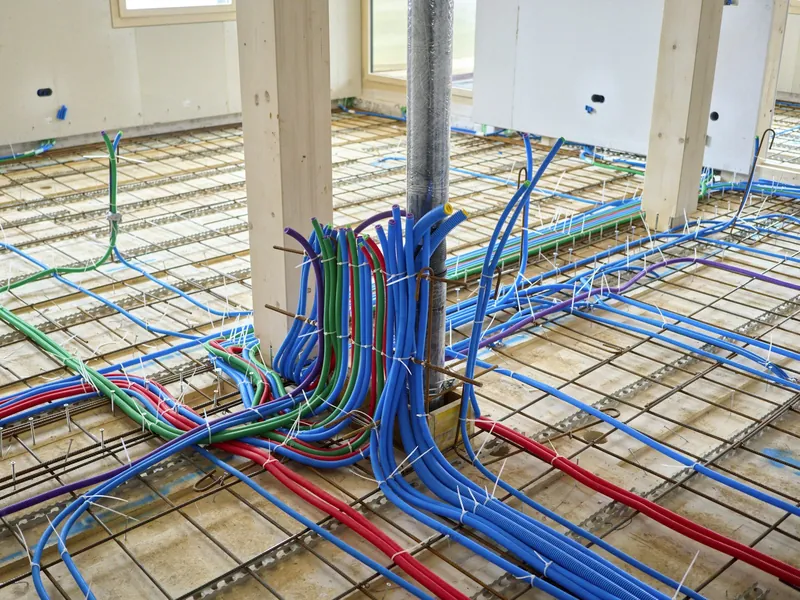
Liquid screed
€24–€36/m²pumped in from a lorry and levelled with a dappling bar- One roomOn the call
- 40 m² extension€960–€1,440
- 75 m² ground floor€1,800–€2,700
- 110 m² house€2,640–€3,960
One room by the bag
€14.64 a bag25 kg of bagged sand and cement screed, with VAT- Without VAT€11.90
- Weight of 1 m² at 50 mm105–110 kg
- Bags for 1 m² at 50 mm4 to 5
Every figure, and what moves it: what floor screed costs in Ireland.
Three ways a floor gets its screed
They do the same job and suit different floors.
Sand and cement
Sharp sand and cement mixed nearly dry, barrowed or pumped in, packed down and trowelled flat by hand. It can be shaped to a slope, so it is the one for wet rooms. €22–€34 a m².
Liquid screed
Poured from a hose and it finds its own level. Thinner than sand and cement and it wraps heating pipes with no air gaps. It cannot hold a slope. €24–€36 a m².
Bagged screed
The same sand and cement in 25 kg bags, about €14.64 each with VAT. For a porch, a hearth or a small bathroom where a lorry makes no sense.
What a whole floor comes to
The area multiplied by the rate. One room is priced on the call.
Extension or open plan (40 m²)
- Sand and cement
- €880–€1,360
- Liquid screed
- €960–€1,440
Ground floor (75 m²)
- Sand and cement
- €1,650–€2,550
- Liquid screed
- €1,800–€2,700
Whole house (110 m²)
- Sand and cement
- €2,420–€3,740
- Liquid screed
- €2,640–€3,960
For a bathroom, a porch or a box room, see screeding one room.
How thick it has to be, in four lines
Depth is set by what the screed sits on, not by taste.
- Stuck to the slab: 25 mm. The least for sand and cement on a prepared concrete slab. 40 mm is what is normally laid. Liquid screed also starts at 25 mm.
- On a membrane: 50 mm. Sand and cement over a damp-proof sheet, not stuck down. Liquid screed can go to 30 mm.
- On insulation: 65 mm. The least for sand and cement on insulation boards in a house, and 75 mm where the floor carries more. Liquid screed starts at 35 mm.
- Over heating pipes: 25 mm of cover. Liquid screed needs that much above the top of the pipe, about 50 mm in all. Sand and cement goes down 65 to 75 mm.
The depth for each kind of job is in how thick, job by job.
A screeder in every county
One contractor takes the floors in each county. Yours goes to the one who works where you live.
Five things a screed quote should say
If one is missing, ask for it before you compare prices.
- The area in m². Measured off the drawings or the floor, room by room, so you can check it.
- The depth in millimetres. A price with no depth on it cannot be compared with another one.
- The screed by name. Sand and cement, with fibres or without, or liquid, and whether that is cement-based or calcium sulphate.
- What it sits on. Stuck to the slab, on a membrane, or on insulation. Each has its own least depth.
- What is not in it. Insulation, membranes, edge strip and heating pipes are often someone else's job. The quote should say whose.
All eight are on the screed cost page.
Before you start
How much does floor screed cost in Ireland?
Floor screed in Ireland runs about €22–€34 a m² in sand and cement, supplied and laid, and €24–€36 a m² in liquid screed, poured. A 40 m² extension comes to €880–€1,360 in sand and cement. A 75 m² ground floor comes to €1,650–€2,550. One room is priced on the call, because a small floor carries a minimum charge.
How thick does a floor screed have to be?
Sand and cement screed is 25 mm at the least when it is stuck to the slab (40 mm is usual), 50 mm on a membrane and 65 mm on insulation in a house. Liquid screed goes thinner: 25 mm stuck down, 30 mm on a membrane, 35 mm on insulation and 25 mm over the top of heating pipes.
How long before I can walk on a new screed?
24 to 48 hours for light foot traffic, for sand and cement and for liquid screed. Leave heavy loads, stacked plasterboard and scaffolding towers off it for a week.
How long does screed take to dry?
Allow a day for every millimetre for the first 50 mm of sand and cement screed and two days for every millimetre after that. A 65 mm screed needs about 80 days before a floor that minds damp goes on it. Liquid screed dries at a day a millimetre up to 40 mm. You can walk on either after 24 to 48 hours.
Is screed the same as concrete?
No. Concrete is the structural slab, with stone in it. Screed is a finer layer of sand and cement, or a liquid screed, laid on top to give a flat surface for the floor finish and to cover insulation and heating pipes.
Do I need liquid screed for underfloor heating?
No, both work. Liquid screed needs only 25 mm over the pipes, so the floor heats faster. Sand and cement goes down 65 to 75 mm and is slower to warm.
Who rings me after I use the planner?
A single screeding contractor in your county rings once, asks about the floor and prices it. Nobody else gets your details.